
News release details
The Canadian Museum for Human Rights (CMHR) will open a new exhibit tomorrow that explores human rights violations related to the ongoing forced displacement of Palestinian Canadians.
Palestine Uprooted: Nakba Past and Present will be on display in the Rights Today gallery on Level 5 until 2028. Featuring personal stories told through artifacts and video testimonies, the exhibit presents Palestinian Canadians reflecting on their ongoing struggle for human rights. The small exhibit reveals enduring patterns of loss and resilience, helping visitors understand more about this contemporary human rights story.
Palestinian Canadian stories are now included alongside many other stories of forced displacement and human rights violations featured in the Museum’s galleries. Each of these stories contributes to our visitors’ understanding of human rights and helps the Museum fulfill its mandate to foster reflection and dialogue.
Exhibition highlights
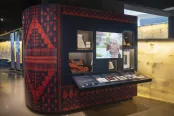
Personal stories and artifacts: Experience firsthand accounts from Palestinian Canadians sharing their journeys of displacement and memory through a series of five artifacts. Cases display artifacts like property deeds, house keys and a traditional Palestinian embroidered dress, accompanied by short videos that deepen understanding of the impacts of displacement.
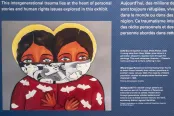
Powerful artworks: In her painting Bound Together in Gaza, Malak Mattar, a Gazan artist, captures the struggles and resilience of her generation shaped by conflict. Her work pays homage to Guernica, Picasso’s powerful masterpiece depicting civilian suffering during war.
Curfews and Closures, by Rajie Cook, bears witness to life under military occupation during the 2000–2005 Palestinian uprising, when curfews and closures were expanded and further limited basic rights and freedoms.
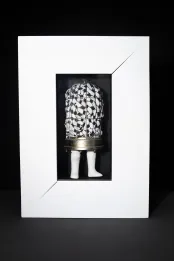
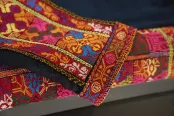
Cultural heritage: Discover traditional Palestinian embroidery called tatreez. Tatreez motifs and colours are tied to place, family history and regional identity. Patterns are associated with particular towns, villages or areas of Palestine. In this way, tatreez is a form of storytelling: a way of preserving memory, sustaining identity and expressing resilience across displacement and exile.
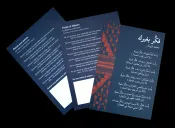
Poetry and reflection: Engage with Mahmoud Darwish’s evocative verses, inspiring personal reflection on exile, voice and responsibility. Visitors can take a card containing Darwish’s poem and add a personal note, fostering ongoing dialogue beyond the exhibit.
Contemporary context: Witness striking images of current events in Gaza and the West Bank, connecting past displacement to ongoing struggles.
Quotes
“No force can silence the truth we carry. Growing up in Canada, my children lived the Nakba through our stories. And now we watch it happen again, live, on our phones. When I see the images coming out of Gaza, I am not watching the news. I am watching my history repeat itself.”
- Fouad Sahyoun, a Palestinian Canadian featured in the exhibit
“We developed this exhibit with a clear awareness that Palestinian Canadian voices have too often been marginalized, silenced or spoken over — and that anti‐Palestinian racism affects whose stories are heard and whose suffering is recognized. That is why we intentionally centred Palestinian Canadian voices throughout the exhibit.”
- Isabelle Masson, Curator of Palestine Uprooted
“Human rights matter precisely when they are inconvenient, when the question of who deserves the dignity of having their rights recognized is genuinely contested. These are the moments where having a national museum for human rights is most important.
There are people who believe this exhibit should not exist in its current form. There are people who believe it should have existed sooner. There are people who will visit this exhibit and feel that it does not say enough, and others who will feel it says too much.
We have listened to every one of these voices. We have reflected. And we have renewed our resolve to continue the difficult, sometimes contested, and often controversial work of building understanding about human rights. We are a museum grounded in Canada's human rights framework, whose mandate requires us to bear witness to the full complexity of the human story. We are proud to open this exhibit because the story it tells will help achieve that mandate, and because this story belongs in the collective memory of Canadians.”
- Isha Khan, CEO