All daytime conference events will take place at the Canadian Museum for Human Rights.
Language and Accessibility:
The conference will be conducted primarily in English with French simultaneous translation. ASL interpretation will be available upon request.
Registration for the conference will close on August 9, 2026.
For the first time ever, the International Network of Museums for Peace Conference is coming to North America. We invite you to join us in Winnipeg, Manitoba, Canada.
This conference will provide an opportunity for knowledge keepers, community leaders, museum workers, artists, activists, and scholars to gather in Winnipeg, on Treaty 1 Territory and the homeland of the Red River Métis, to explore the transformative role museums can play in fostering empathy, decolonization, rematriation/repatriation, promoting human rights and cultivating a culture of peace.
If you are an International Network of Museums for Peace member, or someone who is ready to engage with the conference’s theme, consider attending.
This will be the 12th International Network of Museums for Peace Conference. It is being organized by the Canadian Museum for Human Rights and the International Network of Museums for Peace.
Event details navigation
Conference Pricing and Registration
Main conference sessions (Wednesday, August 12 – Friday, August 14):
Regular price: CAN $550
Student regular price CAN $250
Virtual attendee price for August 13 and 14 sessions: CAN $125
Note
Note that INMP members attending the conference will receive an exclusive welcome package after arrival in Winnipeg.
The cost of optional activities and excursions are not included in conference registration fees. Should attendees choose to participate in these events, they must be booked and paid for by individual attendees.
Themes for this important conference fall into three categories:
Indigenization/decolonization of museums
Peacemaking/human rights
Working in the space of cultural heritage/peacemaking
Conference attendees should anticipate sessions such as:
What can we learn from Indigenous knowledge systems about peace and justice?
Recognizing the connection between colonialism and museums, how can museums and museum workers become co‐creators of peace in communities where they are based, or in communities with whom they work?
How can museums create space for reconciliation, healing and learning beyond their walls?
How can we invite visitors, colleagues, families and communities to rethink their own beliefs and biases, and encourage reflection on our understanding of truth and storytelling?
What are the cutting‐edge methods to educate for peace? What are the roles of stories and storytellers? What is the relationship between affect and action in this work?
How can museums move beyond a limited understanding of “objectivity” or neutrality to take a stand for justice? What are the consequences of doing so?
What are innovative ways that youth can help create, curate and engage with content promoting truth, reconciliation and transitional justice?
What role do museums play in helping communities navigate ongoing conflicts – both domestic and global?
How do stories – including, but not exclusive to, a museum or artistic setting – create experiences that encourage visitors to step into the lives of others?
What do museums and other institutions focused on peacebuilding need to do internally to ensure human rights are lived – and to create and sustain a culture of truth, equity, bravery and fun within their institutions?
How might institutions, including museums and other organizations involved in peacebuilding, transitional justice, truth and reconciliation, better address, prevent and engage with trauma in their work with staff, communities and visitors?
The conference will kick off in a good way starting with a complimentary Explore the Galleries 90‐minute tour of the Museum starting at 3:30 p.m. on Wednesday August 12, followed by an Indigenous cultural experience and ending with a reception.
Thursday, August 13 and Friday, August 14 days will be filled with conference sessions. Mornings will be panel sessions and afternoons will be workshops and round tables. On Friday, August 14, attendees can also visit the Ideas Fair (details to come), a unique opportunity for participants to share their work, initiatives and creations with an international audience.
Closing reception will be held offsite on Friday evening. Reception cost for conference attendees plus one guest included with conference registration.
2:30 p.m. — Registration Opens – Museum Group Entrance
3:30 p.m. — Explore the Galleries tour of the Canadian Museum for Human Rights (*pre‐registration required) – Museum Group Entrance
5:30 p.m. — Welcome Reception – Bonnie & John Buhler Hall
The conference will kick off in a good way with doors opening at 5:00 p.m. Guests will be welcomed by representatives from the Canadian Museum for Human Rights and Winnipeg Economic Development & Tourism, followed by by Indigenous cultural performances. The evening will conclude at 7:00 p.m.
Thursday, August 13
7:30 a.m. — Registration Opens and Breakfast: Bonnie & John Buhler Hall
8:00 a.m. — Welcome Remarks and Opening Ceremony: Bonnie & John Buhler Hall
9:00 – 10:15 a.m. — Morning Panels
Attendees choose one of the following concurrent sessions:
Panel 1: Community collaboration, building bridges and confronting tensions between museums and communities – Manitoba Teachers’ Society Classrooms
Shin Hyun‐oh, Ritsumeikan University (Japan) · Juan Fernando Jaramillo Montoya and Luis Eduardo Vieco Maya, Museo Casa de la Memoria (Colombia)
Panel 2: Centring Indigenous ways of knowing in peacebuilding — Bonnie & John Buhler Hall
I‑Yun Cheng (Elaine), The University of Sydney (Australia) · Takuo Namisashi and Kiwamu Kuriyama, Hosei University (Japan) · Krystal Newcombe, Royal Alberta Museum (Canada)
10:15 – 10:45 a.m. — Morning Break – Bonnie & John Buhler Hall
10:45 a.m. – 12:00 p.m. — Morning Panels
Attendees choose one of the following concurrent sessions:
Panel 3: Land‐based learning and museums as healing spaces – Manitoba Teachers’ Society Classrooms
Junko Kanekiyo, International Network of Museums for Peace · Gianmarco Pisa, Italian Peace Research Institute (Italy) · Mona Badamchizadeh and Janine Müller, International Network of Museums for Peace
Panel 4: Productive discomfort: Techniques for dialogue and reflection – Bonnie & John Buhler Hall
Sierra McKinney, Université de Montréal (Canada) · Emily Chia‐Ying Lin, University of Leicester (United Kingdom) · Melissa Karmen Lee, Chinese Canadian Museum (Canada)
12:00 – 1:00 p.m. — Lunch: Manitoba Teachers’ Society Classrooms
1:00 – 2:15 p.m. — Plenary Workshop, led by Bruno de Oliveira: Bonnie & John Buhler Hall (details to come)
2:15 – 2:45 p.m. — Afternoon Break
2:45 – 4:00 p.m. — Afternoon Sessions
Attendees choose one of the following concurrent sessions:
Roundtable 1: Bearing Witness: Changing perspectives and transforming relationships – Manitoba Teachers’ Society Classrooms
Carey Newman, University of Victoria (Canada) · Isha Khan, CEO, Canadian Museum for Human Rights (Canada)
Panel 5: Innovative approaches to transformative peace education – Bonnie & John Buhler Hall
Faizah Sultana, Center for Alternatives (Bangladesh) · Audhild L. Kennedy, Norsk Industriarbeidermuseum (Norway) · Julie Shackford‐Bradley, University of California, Berkeley (United States)
Buffet dinner is free for conference attendees. . Companion tickets are available for CAN $75; pre‐registration required.
6:30 p.m. — Doors Open: An Evening with Autumn Peltier: Bonnie & John Buhler Hall
7:00 p.m. — Program Begins
Enjoy this rare opportunity to hear from one of the most powerful young voices in the global movement for Indigenous rights and environmental justice, the Canadian Museum for Human Rights is honoured to welcome Autumn for a FREE evening program, open to INMP attendees as well as the public. It promises to inspire, challenge and move audiences of all ages.
Friday, August 14
7:30 a.m. — Info Desk Opens: Museum Group Entrance
7:30 a.m. — Buffet Breakfast and Opening Remarks: Bonnie & John Buhler Hall
7:30 – 8:45 a.m. — Ideas Fair Open: Stuart Clark Garden of Contemplation
8:45 – 9:00 a.m. – Opening remarks – Bonnie & John Buhler Hall
9:00 – 10:15 a.m. — Morning Panels
Attendees choose one of the following concurrent sessions:
Panel 1: Showcasing Museums for Peace – Bonnie & John Buhler Hall
Yukinori Okamura, Maruki Gallery (Japan) · Mona Badamchizadeh and Janine Müller, International Network of Museums for Peace
Workshop 1: Survivor truths in the classroom: Adapting a museum learning program for classrooms across Canada – Manitoba Teachers’ Society Classrooms
James Trepanier and Louis‐Antoine Blanchette, Canadian Museum of History (Canada)
10:15 – 10:45 a.m. — Morning Break
10:45 a.m. – 12:00 p.m. — Morning Panels
Attendees choose one of the following concurrent sessions:
Panel 2: Highlighting the experiences of those working in peace‐based institutions – Manitoba Teachers’ Society Classrooms
Tenzin Topdhen, The Tibet Museum (India) · Amelia Fay, The Manitoba Museum (Canada) · Kya Kim, International Network of Museums for Peace
Panel 3: Peace museums addressing conflicts and colonialism: East Asian case studies – Bonnie & John Buhler Hall
Satoko Oka Norimatsu, Peace Philosophy Centre (Canada) · Ishida Ryuji, Shanghai Jiao Tong University (China) · Zhang Hongbo, Meiji Gakuin University (Japan) · Kaz Nakamoto, The Fukutsukan Museum (Japan) · Eri Kodani, Hitotsubashi University (Japan)
12:00 – 1:00 p.m. — Lunch: Manitoba Teachers’ Society Classrooms
Ideas Fair Open: Stuart Clark Garden of Contemplation
1:00 – 2:30 p.m. — Plenary Workshop — Creative Futures: Bonnie & John Buhler Hall
2:30 – 3:00 p.m. — Afternoon Break and Ideas Fair: Stuart Clark’s Garden of Contemplation
3:00 – 4:15 p.m. — Afternoon Sessions
Attendees choose one of the following concurrent sessions:
Roundtable 1: Peace museums in times of war or oppression – Bonnie & John Buhler Hall
Mona Badamchizadeh, Maryna Bilosludtseva, Sofia Busch, Tanya Maus and Clive Barrett — International Network of Museums for Peace
Workshop 2: Pilgrimage phenomenology in museums: Narrating grassroots and Indigenous journeys and wisdom – Manitoba Teachers’ Society Classrooms
Roy Tamashiro, Webster University (United States) · Jasmine M. Goodnow, Western Washington University (United States) · Ian McIntosh, Indiana University–Indianapolis (United States)
4:15 p.m. — Closing Remarks – Bonnie & John Buhler Hall
4:15 – 5:00 p.m. — Ideas Fair Stuart Clark Garden of Contemplation, INMP Private Members Meeting, Senator Nancy Ruth Board Room
6:00 p.m. — Bus Pick‐Up: Fort Garry Hotel and CMHR
6:30 p.m. — Closing Reception:
Gateway to the Arctic, Assiniboine Park
Reception cost for conference attendees plus one guest included with conference registration.
Travel and accommodation are not included in conference registration fee, and must be booked and paid for by individual attendees.
If you are reserving a flight through Air Canada additional discounts may apply with the use of the promotion code below:
Air Canada promotional code
C24XP861
Hotel
Conference hotels:
Conference rates are available at three Winnipeg hotels:
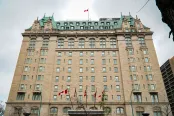
Fort Garry Hotel: CAN$229
Photo: Supplied by Fort Garry Hotel
Fort Garry Hotel is centrally located in Winnipeg’s downtown area; it is a 12‐minute walk from the hotel to the Museum. Rooms are available on a first come, first served basis. Secure your room by July 1, 2026.
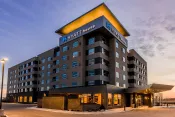
Hyatt House Winnipeg South/Outlet Collection: CAN$129
Photo: Supplied by Hyatt House
Hyatt House Winnipeg South/Outlet Collection is outside of Winnipeg’s downtown area, on the South side of the city near a large retail mall. It is a 25‐minute drive from the hotel to the Museum. Rooms are available on a first come, first served basis. Secure your room by July 1, 2026.
Hampton Inn by Hilton Winnipeg: CAN$189
Photo: Supplied by Hyatt House
Hampton Inn by Hilton Winnipeg is outside of Winnipeg’s downtown area, near Winnipeg International Airport, convenient for those with late airline arrivals or early departures. It is a 20‐minute drive from the hotel to the Museum. Rooms are available on a first come, first served basis. Secure your room by July 1, 2026.
Non‐conference hotels:
Other non‐conference hotels can be explored at the link below. Places to stay.
Known for its friendly and welcoming spirit, Winnipeg is a diverse multicultural city with a rich and varied history. An Indigenous trading centre prior to the arrival of the Europeans, Winnipeg was at the heart of the country’s fur trade and instrumental in developing Canada’s gateway to the west. Home to a grain exchange that once rivalled the largest markets in the world, Winnipeg’s architecture and neighbourhoods reflect the profound character of what was once a small prairie town.
Over the last decades, Winnipeg has developed into a cosmopolitan city complete with top‐notch restaurants, swanky boutiques, exciting attractions and an arts and culture scene that bursts with talent and originality.
91 days or greater of established date (up to May 14, 2026): full refund available minus a processing fee.
60–90 days of established date (up to June 14, 2026): 50% refund available.
0–59 days of established date: No refunds available.
Additional Items:
Substitution allowed: Registrants can transfer their registration to a colleague at no charge, even when refunds are no longer available.
Written cancellation required: Requests must be submitted in writing to be valid.
Exceptions for full refund at any time:
Medical emergencies
Visa denial
Conference cancellation by the CMHR
Force majeure (war, threat of political violence, or extreme weather conditions)
FAQ
What is the International Network of Museums for Peace?
The International Network of Museums for Peace (INMP) is a global, non‐profit organization that connects museums, memorials, and other peace‐related institutions to promote a culture of peace. Established in 1992, its mission is to build global peace through collaboration, shared resources, and promoting public education on peace history, the costs of war, and nonviolence. The network facilitates information sharing, best practices, and international conferences for its members.
What is INMP Conference 2026?
The 2026 conference, called Peacebuilding through truth and reconciliation, will provide an opportunity for knowledge keepers, community leaders, museum workers, artists, activists, and scholars to gather in Winnipeg, on Treaty 1 Territory and the homeland of the Red River Métis, to explore the transformative role museums can play in fostering empathy, decolonization, rematriation/repatriation, promoting human rights and cultivating a culture of peace.
When will Peacebuilding through truth and reconciliation take place?
The conference will take place from 12 to 16 August 2026. Thursday, August 13 and Friday, August 14 days will be filled with conference sessions. After the formal component of the conference concludes, attendees and any companions they may be travelling with are invited to enjoy a curated excursion from Friday, August 14 to Sunday, August 16.
Where will the conference be held?
The conference will be held at the Canadian Museum for Human Rights in the city of Winnipeg, Manitoba.
Known for its friendly and welcoming spirit, Winnipeg is a diverse multicultural city at the centre of Canada with a rich and varied history. An Indigenous trading centre prior to the arrival of the Europeans, Winnipeg was at the heart of the country’s fur trade and instrumental in developing Canada’s gateway to the west. Home to a grain exchange that once rivalled the largest markets in the world, Winnipeg’s architecture and neighbourhoods reflect the profound character of what was once a small prairie town.
Over the last decades, Winnipeg has developed into a cosmopolitan city complete with top‐notch restaurants, swanky boutiques, exciting attractions and an arts and culture scene that bursts with talent and originality.
Who is welcome to attend?
The conference is open to everyone, museum and cultural sector professionals, academics, students, INMP members and non‐members alike. Anyone with an interest in human rights in the cultural sector, from anywhere in the world, is welcome to attend.
What is the theme of the 2026 conference?
Set in a unique place of convergence, dialogue and trade, INMP Conference 2026’s theme is, “Peacebuilding Through Truth and Reconciliation.” Themes that this conference will explore include:
Indigenization/decolonization of museums
Peacemaking/human rights
Working in the space of cultural heritage/peacemaking
What inclusivity and accessibility measures will be in place for conference attendees?
The Canadian Museum for Human Rights is committed to accessibility and the inclusion of persons with disabilities. For further enquiries, please contact: inmpconference2026@humanrights.ca.
In what language(s) will the conference be conducted?
The conference will be conducted primarily in English with French and Spanish simultaneous translation. ASL interpretation will be available upon request.
How can international visitors apply for a visa to attend the conference?
Visa requirements vary by nationality; consult Canada’s official visa resources or embassies.
.jpg?itok=92dpqiJ1)
.jpg?itok=iF1YMIMQ)